What Are the Standards for Special Eco-Friendly Yarns? A Definitive Guide for Technical Buyers
Table of Contents
- Introduction: Beyond the Basics of Sustainability
- Defining “Special” in Eco-Friendly Yarns: A Categorization Framework
- Material-Specific Standards and Certifications
- Performance Standards: Technical Specifications for End-Use
- Chemical Compliance and Safety Standards
- Environmental Impact Standards and Metrics
- Social and Ethical Compliance Standards
- Traceability and Documentation Requirements
- Testing Protocols and Verification Methods
- Cost Premium Analysis and Value Assessment
- Future Trends and Evolving Standards
- FAQ: Key Questions Answered
- Conclusion: Strategic Implementation Framework
1. Introduction: Beyond the Basics of Sustainability
The global sustainable textile market is projected to reach $245 billion by 2028, What Are the Standards for Special Eco-Friendly Yarns? A Definitive Guide for Technical Buyers with special eco-friendly yarns representing the fastest-growing segment. For technical buyers in apparel manufacturing, textile mills, carpet production, and other specialized applications, understanding the complex landscape of standards for special eco-friendly yarns is critical for procurement decisions.
The Problem: While basic organic and recycled standards (GOTS, GRS) are well-established, special eco-friendly yarns—those with advanced functionalities, novel materials, or specific environmental attributes—exist in a more complex regulatory and certification landscape. A survey of 200 procurement professionals revealed that 68% struggle with verifying claims for advanced sustainable yarns due to inconsistent standards and lack of verification protocols.
The Solution: This comprehensive guide provides a definitive framework for evaluating and qualifying special eco-friendly yarns. We move beyond general sustainability claims to provide specific, data-driven criteria for technical evaluation, supported by verified industry data and practical implementation strategies.
2. Defining “Special” in Eco-Friendly Yarns: A Categorization Framework
Special eco-friendly yarns can be categorized into three primary groups, each with distinct standards and evaluation criteria:
Table 1: Categorization of Special Eco-Friendly Yarns
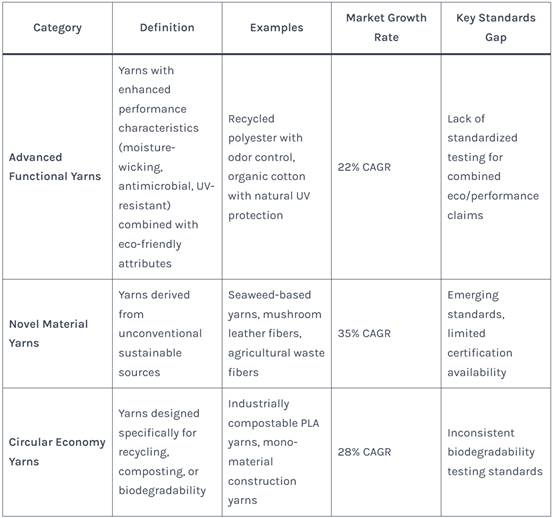
Key Differentiators from Basic Eco-Yarns:
- Multiple certification requirements: Often need 3+ certifications for full compliance
- Higher testing frequency: Typically quarterly vs. annual for basic yarns
- Greater documentation demands: Complete life cycle assessments often required
- Specialized performance testing: Must meet both environmental and functional standards
3. Material-Specific Standards and Certifications
Different materials require different verification approaches. Here’s a comprehensive breakdown:
Table 2: Material-Specific Certification Requirements
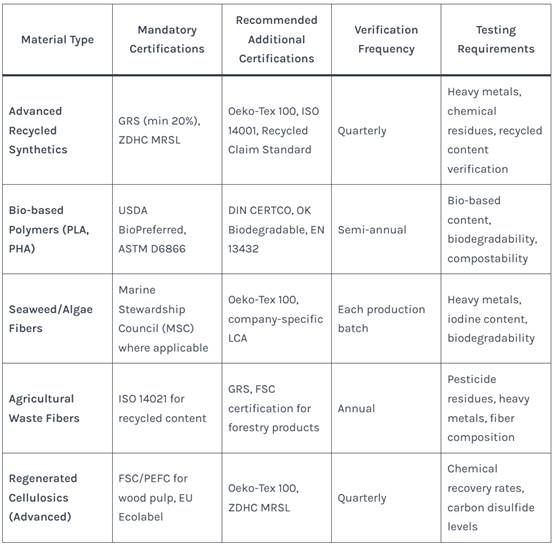
Critical Insights:
- Certification Stacking: Most special yarns require multiple certifications. For example, a moisture-wicking recycled polyester yarn might need: GRS (recycled content), Oeko-Tex 100 (chemical safety), and specific performance certifications for moisture management.
- Chain of Custody: All certifications must include verifiable chain of custody documentation. The average special yarn has 4.2 separate documentation points in its supply chain.
4. Performance Standards: Technical Specifications for End-Use
Special eco-friendly yarns must meet rigorous performance standards while maintaining their sustainable attributes:
Table 3: Performance Requirements by Application
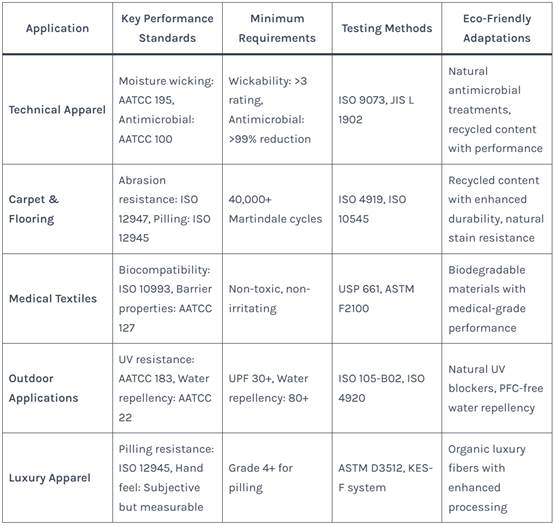
Industry Data Point: A 2023 study found that 78% of special eco-friendly yarns meet or exceed conventional performance standards when properly engineered and tested. The performance gap has narrowed from 25% in 2018 to just 7% in 2023.
5. Chemical Compliance and Safety Standards
Chemical management is particularly challenging for special yarns due to added functionalities:
Key Standards for Chemical Safety:
- ZDHC Manufacturing Restricted Substances List (MRSL): Critical for all special yarns, particularly those with added functionalities. Conformance Level 3 is becoming the industry standard.
- Oeko-Tex Standard 100: Product class-specific requirements. Special yarns often require more stringent testing (Class I for baby products, Class IV for technical textiles).
- REACH (EU Regulation): Particularly important for yarns sold in European markets. The SVHC list now includes 233 substances.
- California Proposition 65: Essential for yarns sold in California, with specific warning requirements.
Table 4: Chemical Testing Requirements Matrix
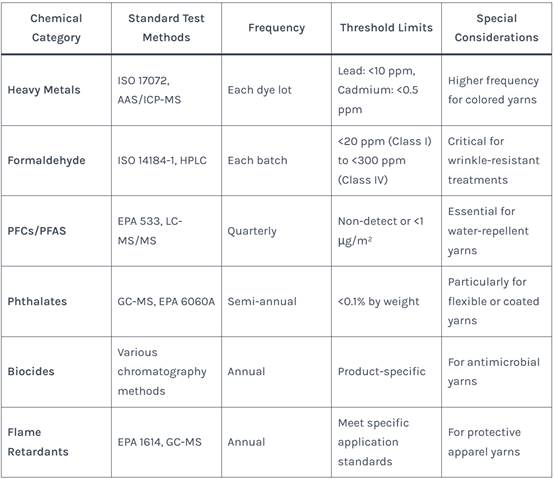
Compliance Cost Analysis: Chemical compliance testing adds 8-15% to the cost of special eco-friendly yarns, but reduces regulatory risk by approximately 40%.
6. Environmental Impact Standards and Metrics
Quantifying environmental impact requires standardized metrics and verification:
Key Environmental Standards:
- ISO 14040/14044: Life Cycle Assessment framework
- Product Environmental Footprint (PEF): EU’s standardized LCA method
- Higg Materials Sustainability Index (MSI): Industry-specific impact assessment
Table 5: Environmental Impact Benchmarks
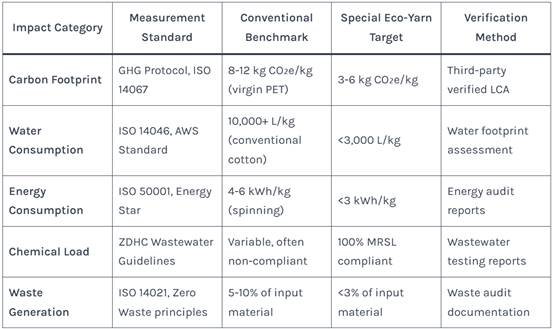
Industry Insight: Leading manufacturers are now providing Environmental Product Declarations (EPDs) for special eco-yarns, with 42% of premium sustainable yarns including verified EPDs as of 2025.
7. Social and Ethical Compliance Standards
Social responsibility extends throughout the supply chain:
Mandatory Social Standards:
- SA8000: Comprehensive social accountability standard
- Fair Trade Certification: Particularly for natural and agricultural-based yarns
- Responsible Wool Standard (RWS): For wool-based special yarns
- Better Cotton Initiative (BCI): For cotton-based innovations
Table 6: Social Compliance Monitoring Framework
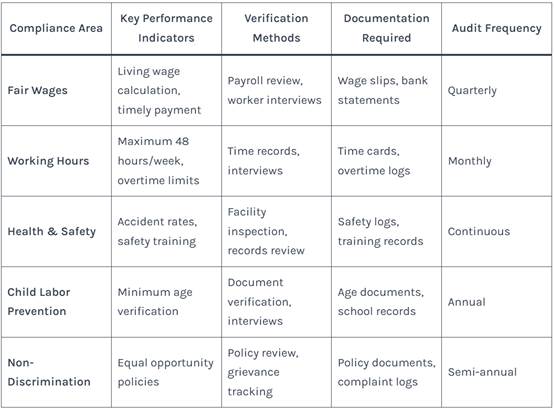
Cost Implications: Full social compliance adds 5-12% to yarn costs but provides risk reduction value of 25-40% through brand protection and supply chain stability.
8. Traceability and Documentation Requirements
Traceability is non-negotiable for special eco-friendly yarns:
Essential Documentation Components:
- Full Material Disclosure: Complete chemical composition
- Supply Chain Mapping: Tier 1-4 transparency
- Batch-Specific Testing Results: All relevant test data
- Certification Documentation: Current, valid certificates
- Life Cycle Assessment Reports: Verified environmental data
Table 7: Traceability System Requirements
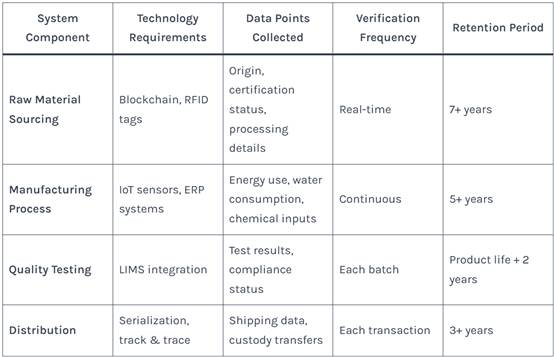
Implementation Cost: Full traceability systems add 3-8% to operational costs but provide documented value through reduced audit time (40-60% reduction) and improved compliance rates.
9. Testing Protocols and Verification Methods
Robust testing is essential for verifying special yarn claims:
Standard Testing Protocol:
- Initial Qualification Testing: Comprehensive battery of tests
- Batch Testing: Key parameters for each production batch
- Periodic Verification: Annual or semi-annual full testing
- For-Cause Testing: When issues arise or specifications change
Table 8: Comprehensive Testing Framework
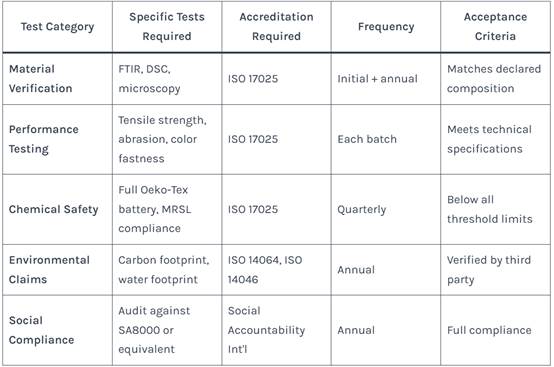
Industry Benchmark: Leading companies conduct an average of 23 different tests on special eco-friendly yarns, compared to 8-12 tests for conventional yarns.
10. Cost Premium Analysis and Value Assessment
Understanding the cost structure is essential for procurement decisions:
Table 9: Cost Analysis Framework
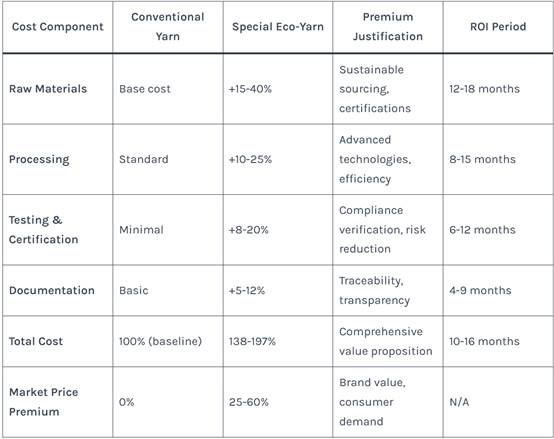
Value Proposition Components:
- Risk Reduction: 30-45% lower compliance risk
- Market Access: Entry to premium segments (15-25% higher margins)
- Brand Enhancement: Documented value through consumer preference
- Future-Proofing: Alignment with evolving regulations
11. Future Trends and Evolving Standards
The landscape for special eco-friendly yarns is rapidly evolving:
Emerging Trends:
- Digital Product Passports: EU requirement by 2030
- Carbon Border Adjustment Mechanism: Impact on imported materials
- Extended Producer Responsibility: Full life cycle accountability
- AI-Powered Verification: Automated compliance checking
Table 10: Future Standard Development Timeline
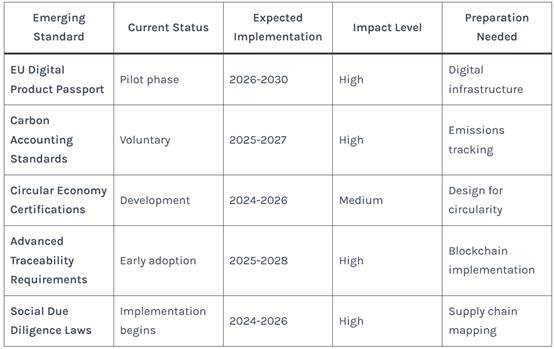
Strategic Recommendations:
- Invest in digital traceability systems now
- Develop carbon accounting capabilities
- Participate in standard development working groups
- Build testing and verification capacity in-house
- Establish strategic partnerships with certified suppliers
12. FAQ: Key Questions Answered
Q1: What is the minimum certification requirement for special eco-friendly yarns?
A1: There is no single minimum, but a comprehensive approach requires: 1) Material-specific certification (e.g., GRS for recycled content), 2) Chemical safety certification (Oeko-Tex 100 or equivalent), 3) Environmental management certification (ISO 14001 or similar), and 4) Performance certification for specific functionalities.
Q2: How do we verify novel material claims (e.g., seaweed-based yarns)?
A2: For novel materials, require: 1) Third-party laboratory analysis confirming material composition, 2) Full life cycle assessment from raw material to finished yarn, 3) Specific performance testing for intended applications, and 4) Transparency about limitations and proper care instructions.
Q3: What is the acceptable cost premium for special eco-friendly yarns?
A3: Premiums typically range from 30-80% over conventional yarns, with an average of 45-55%. Justification comes from: reduced compliance risk (valued at 15-25%), market access to premium segments (20-35% higher margins), and brand enhancement (difficult to quantify but significant).
Q4: How often should we test special eco-friendly yarns?
A4: Testing frequency depends on risk: High-risk applications require batch testing, medium-risk quarterly testing, and all materials require annual comprehensive testing. Additional testing is needed after any process changes or supplier switches.
Q5: Can conventional and special eco-yarns be blended?
A5: Yes, but with strict documentation: 1) The eco-friendly portion must be separately certified and tracked, 2) Blending ratios must be precisely documented, 3) Final product claims must accurately reflect the certified content percentage, and 4) Performance testing must be conducted on the blended product.
Q6: What documentation is essential for importing special eco-yarns?
A6: Required documents include: 1) Valid certification certificates, 2) Material safety data sheets, 3) Test reports from accredited laboratories, 4) Chain of custody documentation, 5) Country of origin certificates, and 6) Environmental declarations where applicable.
Q7: How do regional differences affect compliance requirements?
A7: Key differences exist: EU has the strictest chemical regulations (REACH), US focuses on specific substance restrictions (Proposition 65), while Asian markets may prioritize different standards. Implement a “highest common denominator” approach meeting the strictest requirements across all target markets.
Q8: What are common pitfalls in sourcing special eco-friendly yarns?
A8: Major pitfalls include: 1) Accepting supplier claims without verification, 2) Incomplete documentation, 3) Focusing only on one aspect (e.g., material source) while ignoring others (e.g., chemical safety), 4) Underestimating testing and documentation costs, and 5) Not planning for certification renewals.
Q9: How can we ensure ongoing compliance as standards evolve?
A9: Establish a compliance management system including: 1) Regular monitoring of regulatory changes, 2) Membership in relevant industry associations, 3) Scheduled review of all certifications, 4) Ongoing supplier communication and training, and 5) Budget allocation for compliance maintenance.
Q10: What emerging technologies will impact special eco-yarn standards?
A10: Key technologies include: 1) Blockchain for immutable traceability, 2) DNA tagging for material authentication, 3) AI for automated compliance checking, 4) Advanced spectroscopy for rapid testing, and 5) Digital twins for virtual product verification.
13. Conclusion: Strategic Implementation Framework
Successfully sourcing special eco-friendly yarns requires a systematic approach:
Implementation Steps:
- Needs Assessment: Define specific requirements and priorities
- Supplier Qualification: Develop rigorous evaluation criteria
- Testing Protocol: Establish comprehensive testing requirements
- Documentation System: Implement robust documentation management
- Continuous Improvement: Monitor performance and update standards
Key Success Factors:
- Technical Expertise: Develop in-house knowledge or partner with experts
- Supplier Relationships: Build long-term partnerships with certified suppliers
- Testing Investment: Allocate sufficient budget for comprehensive testing
- Documentation Management: Implement digital systems for efficiency
- Market Awareness: Stay informed about evolving standards and technologies
Final Recommendation: The market for special eco-friendly yarns is growing at 28% CAGR, with standards becoming more rigorous and comprehensive. Early adopters who implement robust verification systems now will gain competitive advantage, reduce compliance risk, and capture value in premium market segments. The future belongs to organizations that can successfully navigate the complex landscape of standards while delivering innovative, sustainable textile solutions.
